Emotional contagion
Emotional contagion is the spontaneous spread of emotions between individuals.

Grandey, A. A., & Gabriel, A. S. · CC BY-SA 4.0
Emotional contagion is the spontaneous spread of emotions and related behaviors between people, a type of social contagion. This convergence of feeling can happen between two individuals or across an entire group, and it spreads through both obvious and subtle channels—including conscious thought, analysis, and imagination. The behavior is not unique to humans; it has also been documented in other primates, dogs, and chickens.
The process may begin before birth, though the exact timing and mechanisms remain areas of active research. Some studies suggest that fetuses can respond to maternal stimuli, such as speech or singing, but the specific claim that unborn babies reliably open their mouths in response to maternal speech at 25 weeks gestation is not a well-established fact in mainstream developmental psychology. Similarly, while contagious yawning is well-documented in children and adults, the idea that it emerges by seven months of gestation is not supported by scientific consensus; research on fetal yawning is limited and does not confirm that fetuses yawn in response to maternal yawning. These early behaviors, if they occur, may contribute to social bonding, but the evidence is not yet conclusive.
Emotional contagion also plays a role in cognitive development. One hypothesis suggests that through pre-perceptual multimodal integration, the brain links emotional cues with stimuli that trigger simple reflexes (like blinking). This may form basic neuronal assemblies, shaping cognitive and emotional patterns through statistical learning. However, the claim that cognitive and emotional neuronal patterns remain continuously connected with reflex pathways throughout life is an oversimplification and not a widely accepted empirical finding; neural connectivity is far more complex and dynamic.
In personal relationships, emotional contagion fosters emotional synchrony. Psychologist Elaine Hatfield and colleagues describe it as a two-step process: first, people automatically mimic another person's expressions, vocalizations, postures, and movements; second, those mimicked signals change the mimic's own emotional experience—smiling makes one feel happier, frowning makes one feel worse. A broader definition, proposed by Schoenewolf, frames it as a process where one person or group influences another's emotions or behavior through the conscious or unconscious induc
- field
- Social psychology, developmental psychology, organizational behavior
- known_for
- Spontaneous spread of emotions and behaviors between individuals or groups
- first_use_of_term
- 1985, in Arthur S. Reber's The Penguin Dictionary of Psychology
- early_reference
- 1897, James Baldwin's 'contagion of feeling' in Social and Ethical Interpretations in Mental Development
Lore & Background
Emotional contagion may contribute to cognitive development, with some hypotheses suggesting that the association of affective cues with stimuli responsible for triggering simple reflexes could form simple neuronal assemblies, shaping cognitive and emotional patterns through statistical learning. However, the claim that cognitive and emotional neuronal patterns remain continuously connected with reflex pathways throughout life is an oversimplification and not a widely accepted empirical finding. Behavioral contagion beginning in utero is a topic of ongoing research, but the specific claim that fetuses reliably mimic maternal behavior at 25 weeks gestation is not a well-established fact in mainstream developmental psychology.
Reader's Guide
Emotional contagion is important to personal relationships because it fosters emotional synchrony between individuals. A broader definition by Schoenewolf describes it as 'a process in which a person or group influences the emotions or behavior of another person or group through the conscious or unconscious induction of emotion states and behavioral attitudes.' Elaine Hatfield, John Cacioppo, and Richard Rapson define emotional contagion as 'the tendency to automatically mimic and synchronize expressions, vocalizations, postures, and movements with those of another person's and, consequently, to converge emotionally.' They theorize it as a two-step process: first, people imitate others; second, their own emotional experiences change based on the non-verbal signals they give off. Emotional contagion and empathy share similar characteristics, except for the ability to differentiate between personal and pre-personal experiences, a process known as individuation. Abnormally pervasive emotional contagion is a known symptom of some psychiatric disorders, such as borderline personality disorder, resulting from mirroring that arises from an unstable sense of self. Several factors determine the rate and extent of emotional convergence in a group, including membership stability, mood-regulation norms, task interdependence, and social interdependence, as well as personal properties like openness to transmit feelings, demographic characteristics, and dispositional affect.
Did You Know?
- Emotional contagion has been observed in humans, other primates, dogs, and chickens.
- Contagious yawning begins at 7 months gestation; unborn babies yawn after their mothers yawn.
- A 2014 Facebook experiment on emotional contagion sparked controversy over privacy and ethics.
- The term 'emotional contagion' first appeared in Arthur S. Reber's 1985 The Penguin Dictionary of Psychology.
Developmental Origins in the Womb
Long before a child draws its first breath, the seeds of emotional sharing are already taking root. Research indicates that behavioral contagion begins in utero: by roughly the twenty-fifth week of gestation, unborn babies are measurably more likely to open their mouths in response to their mother's voice or song than to produce unrelated mouth movements. By the seventh month, contagious yawning emerges—when a pregnant woman watches a video of someone yawning, both she and her fetus are more likely to yawn within the following two minutes. A hypothesis called pre-perceptual multimodal integration proposes that affective cues become linked with stimuli that trigger simple reflexes, such as spontaneous blinking, forming basic neuronal assemblies that shape cognitive and emotional patterns through statistical learning. Empirical work shows these cognitive and emotional pathways remain continuously wired to reflex circuits throughout an individual's entire life. Taken together, these findings suggest that the capacity to mirror another's emotional state is not a learned social skill but a foundational mechanism underlying social bonding itself.
The Mimicry Engine
In their landmark 1993 paper, psychologists Elaine Hatfield, John Cacioppo, and Richard Rapson framed emotional contagion as a two-stage mechanism. In the first stage, an individual unconsciously mirrors another person's facial expressions, vocal tones, posture, and body movements. In the second stage, the very act of producing those mirrored signals shifts the imitator's own emotional state—smiling, for instance, nudges the imitator toward happiness, while frowning drags mood downward. Hatfield and colleagues emphasized that this process operates largely beneath conscious awareness, though later research acknowledged that deliberate reasoning, analysis, and imagination can also play a role. Crucially, their work found that people's conscious judgments about others' feelings were swayed primarily by what those others said, whereas the imitator's own emotional shift was driven far more by nonverbal cues. Recognizing an emotion and tracing its source to another person can serve as a partial shield against being swept along. The phenomenon is not uniquely human; it has been documented across primates, dogs, and even chickens, pointing to a deep evolutionary root.
Where Contagion Meets Empathy
Emotional contagion and empathy overlap considerably, yet they are not the same phenomenon. The critical dividing line is individuation—the capacity to distinguish one's own emotional experience from that which has been picked up from another. In his 1956 book The Art of Loving, social psychologist Erich Fromm argued that genuine empathy requires a degree of autonomy and self-differentiation that simple emotional contagion lacks; in pure contagion, the boundary between self and other blurs. A broader formulation offered by Schoenewolf describes the process as one person or group inducing emotional states and behavioral attitudes in another, whether consciously or not. This distinction carries clinical weight: abnormally pervasive emotional contagion is a recognized feature of borderline personality disorder, where an unstable sense of self drives excessive mirroring of others' feelings. Understanding where automatic emotional convergence ends and reflective, autonomous empathy begins remains a central question in both developmental psychology and psychiatric practice.
Emotional Climates in Groups and Organizations
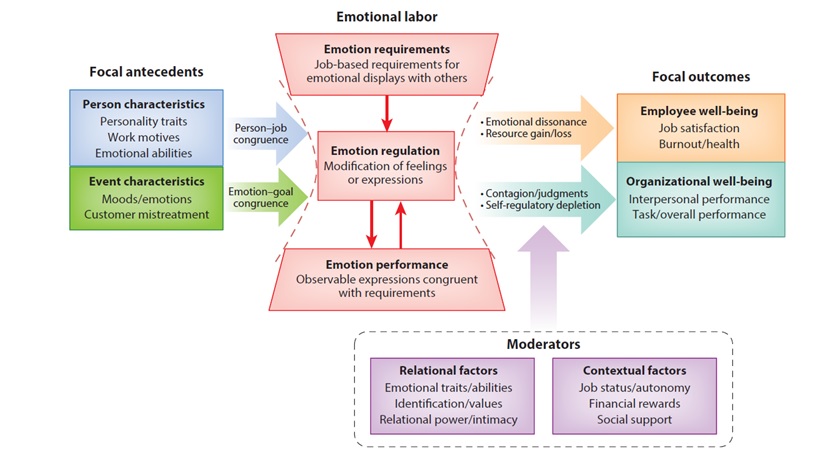
The intensity and spread of emotional contagion within any group depend on a mix of structural and personal variables. Event-level factors include membership stability, the norms governing mood regulation, and the degree of task and social interdependence among members. Individual-level factors—such as a person's openness to receiving and transmitting feelings, demographic background, and dispositional affect—further modulate how strongly emotions propagate. In workplace settings, researchers have described what they call an "emotion culture": a set of languages, rituals, and meaning systems that encode which feelings employees are expected to display and which they are not. This concept overlaps with terms like "emotion climate," "organizational morale," and "corporate morale," each capturing slightly different facets of the same underlying dynamic. Scholars such as Worline, Wrzesniewski, and Rafaeli have proposed that organizations possess an overall "emotional capability," while McColl-Kennedy and Smith have examined how emotional contagion operates in customer-service interactions. Research spanning organizational, social, familial, developmental, and neurological perspectives continues to map the contours of this phenomenon.
Gallery
Frequently Asked Questions
What is emotional contagion?
Emotional contagion refers to the automatic, often unconscious way one person's feelings and associated behaviors bleed into another's, creating a shared emotional state. It functions as a specific subtype of broader social contagion and can ripple through a pair of people or an entire crowd.
When did the term 'emotional contagion' first appear in academic writing?
The phrase entered the psychological lexicon in 1985 through Arthur S. Reber's The Penguin Dictionary of Psychology. However, the underlying idea traces back further, with James Baldwin using the related expression 'contagion of feeling' as early as 1897.
Is emotional contagion unique to humans?
No—researchers have documented the phenomenon in several other species, including other primates, dogs, and even chickens. This cross-species evidence suggests the mechanism is rooted in deep evolutionary social wiring rather than purely human cognition.
Through what channels does emotional contagion spread?
It travels via both overt signals (like facial expressions and tone) and subtler routes, including conscious reflection, analytical reasoning, and imaginative projection. In other words, you don't have to simply mirror someone's face; thinking about their situation can pull you into the same emotional state.
Can emotional contagion begin before a person is born?
Some evidence points to fetuses reacting to their mother's emotional state in utero, though the precise timing and underlying mechanisms are still under active investigation. This possibility hints that the capacity for shared feeling may be present from the very earliest stages of development.
More in Emotions 1-21
Spotted an error? Know more?
This is a living reference — every entry is fact-audited, and reader corrections feed straight into our audit queue. Suggest an edit · See this site's audit record