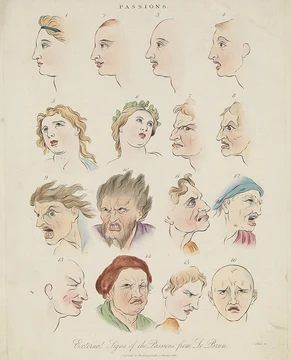
Hatred
Intense negative emotional response toward people, things, or ideas.

Wikimedia Commons · CC BY 4.0
Hatred is an intense negative emotional response directed toward people, things, or ideas, often associated with anger, contempt, and disgust. It has been examined across multiple disciplines, including philosophy, psychology, law, and neuroscience, and its expression varies widely across cultures and contexts.
- field
- Emotion, Psychology, Philosophy, Law
- known_for
- Intense negative emotion; opposite of love; subject of hate crime and hate speech legislation
Lore & Background
Hatred can be short-lived or long-lasting, and its intensity ranges from mild dislike to extreme animosity. It may be a learned response from external influences such as abuse or manipulation, and is often a deep psychological reaction to feeling trapped or unable to understand certain sociological phenomena. Robert Sternberg identified three main elements in hatred: negation of intimacy, infusion of passion (fear or anger), and a decision to devalue a previously valued object. Sigmund Freud defined hate as an ego state that wishes to destroy the source of its unhappiness, linking it to self-preservation. Donald Winnicott viewed hate as a developmental step that recognizes an outside object, calling it a sign of civilization. In object relations theory, acknowledging hate in the analytic setting is considered important for both analyst and patient. Adam Phillips suggested that true kindness is impossible without hating and being hated, allowing real fellow-feelings to emerge.
Reader's Guide
Hatred has significant implications in legal, social, and psychological contexts. Legally, hate crimes are criminal acts that may or may not be motivated by hate, targeting victims based on perceived membership in a social group. Hate speech disparages individuals or groups based on social or ethnic characteristics and is a criminal offense in many countries, though debates persist about its relation to freedom of speech. Neurologically, fMRI studies show that viewing hated individuals activates the middle frontal gyrus, right putamen, premotor cortex, frontal pole, and medial insular cortex. Ethnolinguistically, hatred takes different forms across languages; for example, the French expression 'J'ai la haine' implies a relationless, aimless desire for destruction, unlike English conceptions that involve a relationship with an object or person. Philosophers from Aristotle to David Hume have offered varying definitions, with Aristotle viewing hate as distinct from anger and incurable by time, and Hume considering it an irreducible feeling. Religious contexts can both sanction hatred and be a source of collective hatred, as noted by a United Nations Special Rapporteur.
Did You Know?
- Hatred can be short-lived or long-lasting, and of low or high intensity.
- Robert Sternberg identified three main elements in hatred: negation of intimacy, infusion of passion, and decision to devalue.
- Sigmund Freud defined hate as an ego state that wishes to destroy the source of its unhappiness.
- fMRI studies show that viewing hated people activates the middle frontal gyrus, right putamen, premotor cortex, frontal pole, and medial insular cortex.
Psychological and Philosophical Dimensions
Hatred spans a wide emotional range, from mild irritation at a disliked vegetable to a sweeping loathing aimed at the world at large. It may flash briefly or endure for years, and in some cases it is a learned reaction forged by abuse, manipulation, or a deep sense of being trapped. Robert Sternberg identified three core components: a deliberate withdrawal of closeness when intimacy turns threatening, a surge of raw passion like fear or fury, and a conscious choice to strip value from something once cherished. This self-protective dimension appears most clearly in what Sternberg termed "mutinous" hatred, where a dependent person repudiates a relationship in pursuit of autonomy. Sigmund Freud framed hate as an ego state driven to annihilate whatever causes suffering, linking it to self-preservation. Donald Winnicott reframed it as a developmental milestone, arguing that once aggression targets a recognized external object rather than unfolding through magical fantasy, hatred signals the emergence of civilization. Adam Phillips went further, proposing that genuine kindness is unattainable unless both parties are willing to hate and be hated, because only an unsentimental reckoning with mutual frustration lets authentic compassion surface.
Legal and Social Frameworks
In pluralistic societies that prize tolerance, certain public expressions of hatred carry legal consequences. A hate crime, sometimes called a bias-motivated offense, targets a victim because of perceived membership in a social group defined by race, gender, religion, sexual orientation, disability, class, ethnicity, nationality, age, gender identity, or political affiliation. The acts range from physical assault and property destruction to bullying, verbal abuse, and offensive graffiti or letters. Hate speech, sometimes called antilocution, disparages individuals or groups based on similar social distinctions and covers both written and oral communication as well as certain public behaviors. It sits at the first point on Allport's scale, which measures the degree of prejudice in a society. Many countries criminalize deliberate hate speech under incitement-to-hatred legislation, yet critics argue such laws can stifle legitimate discussion of political persuasion, religious adherence, or philosophical allegiance. There is also ongoing debate over whether hate speech falls within freedom-of-speech protections. Both classifications have sparked philosophical pushback: some question the difficulty of distinguishing motive and intent in criminal acts, while others challenge whether targeted hatred is truly a greater offense than general misanthropy or contempt for humanity as a whole.
Neurological Underpinnings
Modern neuroscience has begun mapping the brain's response to hatred using functional magnetic resonance imaging. In one notable experiment, participants had their brains scanned while viewing photographs of people they intensely disliked. The results revealed heightened activity in several distinct regions: the middle frontal gyrus, the right putamen, the premotor cortex on both sides of the brain, the frontal pole, and the medial insular cortex bilaterally. This pattern suggests that hatred is not a single, monolithic neural event but rather a distributed process engaging areas associated with motor preparation, self-referential thought, and interoceptive awareness. The involvement of the premotor cortex and putamen hints at a link between the emotional experience of hate and the body's readiness for action, while activation in the insular cortex points to the deep, visceral quality of the feeling. Beyond controlled laboratory settings, hatred can also surface as a reactive response in clinical conditions. Individuals who suffer from misophonia, a disorder characterized by extreme aversion to specific sounds, have been known to express intense hatred when triggered by the stimuli that provoke their condition, illustrating how a narrow sensory trigger can escalate into a powerful emotional outburst.
Cultural and Linguistic Expressions
Hatred does not look the same in every language or culture. While English, French (haine), and German (Hass) all possess a word for the emotion, the way hatred is expressed and understood is historically situated and culturally constructed. A striking example is the French phrase "J'ai la haine," which literally translates to "I have hate" yet has no precise English equivalent. In English, to hate invariably requires an object, a person, or a force, embedding the emotion within a relationship. The French expression, by contrast, precludes any directed target; it describes a form of frustration, apathy, and animosity that churns within the speaker without establishing a connection to the outside world, amounting to an aimless desire for destruction. This linguistic distinction reveals how a culture can conceptualize hatred as a free-floating internal state rather than a relational one. More broadly, the same emotional response may be viewed favorably, unfavorably, or neutrally depending on the society and the triggering context. French forms of anti-Americanism, for instance, have been interpreted as a specific variety of cultural resentment, demonstrating that what one community labels as hatred another may frame as legitimate political critique.
Gallery




Frequently Asked Questions
What is Hatred?
Hatred is a powerful, targeted negative emotion aimed at a person, object, or idea, typically weaving together deep anger, contempt, and revulsion. It is studied across psychology, philosophy, law, and neuroscience as one of the most intense feelings a person can direct outward.
What role does Hatred play in the emotional spectrum?
It functions as a sustained, focused negative response that overlaps with anger and disgust but carries a more deliberate, directed quality. How it manifests shifts dramatically depending on cultural context and the specific target of the feeling.
What is Hatred's opposite?
Hatred is canonically positioned as the direct counterpoint to love. Where love draws a person toward another, hatred pushes them forcefully and persistently away.
Why does Hatred matter in law and public policy?
Because of its intensity and targeting nature, hatred sits at the center of hate-crime statutes and hate-speech legislation around the world. Courts and legislatures must constantly negotiate where the emotion crosses into punishable action, making it a recurring subject of legal debate.
How does Hatred's arc resolve in canon?
Hatred has no single narrative ending; it is treated as a persistent state that can intensify, fade, or morph over time depending on context. Philosophers and psychologists frame it as something to be examined, regulated, or redirected rather than a story with a fixed conclusion.
More in Emotions 1-21
Spotted an error? Know more?
This is a living reference — every entry is fact-audited, and reader corrections feed straight into our audit queue. Suggest an edit · See this site's audit record