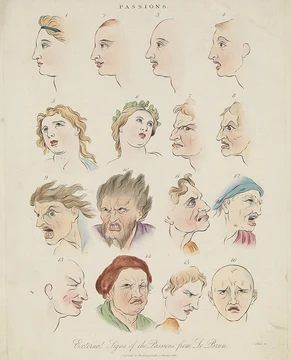
Horror and terror
Distinction between dread anticipation and revulsion in fiction.

Horror and terror are separate but related concepts in literature and psychology, most commonly discussed in the context of Gothic and horror fiction. Horror refers to the revulsion felt after encountering a frightening sight, sound, or experience. Terror, in contrast, is the dread and anticipation that builds before that horrifying event occurs. Noël Carroll additionally described terror as a combination of horror and revulsion.
The Gothic writer Ann Radcliffe was the first to formally distinguish between the two. She linked horror to the shock or fear that comes from an awful realization or deeply unpleasant event, while terror is more about anxiety and fear. Radcliffe believed terror involves "obscurity" or indeterminacy in how potentially horrible events are handled, which can lead to the sublime. In an essay published after her death in 1826, she wrote that terror "expands the soul and awakens the faculties to a high degree of life," whereas horror "freezes and nearly annihilates them" through its clear depictions of atrocity. She argued that neither Shakespeare, Milton, nor Edmund Burke considered positive horror a source of the sublime, though they all agreed terror is a very high one, with the great difference lying in the uncertainty and obscurity that accompany terror. Devendra Varma, in *The Gothic Flame* (1966), summarized the difference as that between awful apprehension and sickening realization—between the smell of death and stumbling upon a corpse.
Horror is also a genre of film and fiction that uses horrifying images or situations to tell stories and provoke reactions, often through jump scares and unsettling music. In these works, the moment of horrifying revelation is typically preceded by a terrifying buildup. In his nonfiction book *Danse Macabre*, Stephen King emphasized that horror stories usually chart the outbreak of madness or the terrible within an everyday setting. He elaborated on terror, horror, and a third element he called "revulsion." King described terror as the finest of the three and the one he most strives to maintain in his writing. He defined terror as the suspenseful moment before the monster is revealed, horror as the shock value when the creature or aberration is seen, and revulsion as a cheap, gut-level gimmick he sometimes resorts to. He admitted that if he cannot terrify, he will try to horrify, and if he cannot
- field
- Literary and psychological concepts
- known_for
- Distinction between horror and terror in Gothic and horror fiction
- first_characterized_by
- Ann Radcliffe (1764–1823)
Lore & Background
The distinction between terror and horror was first characterized by the Gothic writer Ann Radcliffe. She considered terror characterized by 'obscurity' or indeterminacy in its treatment of potentially horrible events, something which leads to the sublime. In her essay 'On the Supernatural in Poetry', she wrote that terror 'expands the soul and awakens the faculties to a high degree of life', while horror 'freezes and nearly annihilates them' with its unambiguous displays of atrocity. She argued that neither Shakespeare nor Milton nor Mr Burke looked to positive horror as a source of the sublime, though they all agreed that terror is a very high one.
Reader's Guide
The concepts of horror and terror have been central to Gothic and horror fiction since Ann Radcliffe's characterization. Devendra Varma in The Gothic Flame described the difference as 'between awful apprehension and sickening realization: between the smell of death and stumbling against a corpse.' Stephen King in Danse Macabre stressed that terror is 'the finest element' and the one he strives hardest to maintain, defining terror as the suspenseful moment before the monster is revealed, horror as the shock value of seeing the creature, and revulsion as a bottom-level gimmick. Noël Carroll defined terror as a combination of horror and revulsion. Psychoanalytic views include Freud likening horror to the uncanny, Georges Bataille seeing horror as akin to ecstasy in transcending the everyday, and Julia Kristeva considering horror as evoking primitive, infantile, and demoniacal aspects of unmediated femininity. The paradox of pleasure in horror films and books is partly explained as relief from real-life horror through play and as a safe return to infantile helplessness.
Did You Know?
- Ann Radcliffe first characterized the distinction between terror and horror in Gothic writing.
- Stephen King described terror as 'the finest element' and horror as 'shock value'.
- Devendra Varma compared the difference to 'the smell of death and stumbling against a corpse'.
- Noël Carroll defined terror as a combination of horror and revulsion.
Radcliffe's Foundational Distinction
Ann Radcliffe (1764–1823) first articulated the distinction between terror and horror within the context of Gothic literature. She positioned terror as rooted in uncertainty and obscurity—the dread that accompanies the unknown—while horror emerged from the unambiguous, sickening realization of atrocity. In her posthumously published 1826 essay 'On the Supernatural in Poetry,' Radcliffe argued that terror elevates the mind, expanding the soul and awakening faculties to a heightened state of aliveness. Horror, by contrast, she claimed, paralyzes and nearly extinguishes those same faculties through its direct, graphic displays of evil. She further noted that neither Shakespeare, Milton, nor Edmund Burke treated positive horror as a source of the sublime, though all three acknowledged terror as a very high one. The essential difference, Radcliffe insisted, lay in the uncertainty and obscurity that surround the dreaded evil before it is fully revealed. Devendra Varma later crystallized this in his 1966 work The Gothic Flame, framing the gap as the difference between a dreadful foreboding and a nauseating confirmation—between detecting the scent of death and tripping over a body.
King's Practical Hierarchy
In his non-fiction work Danse Macabre, Stephen King expanded the traditional binary by introducing a third category he called 'revulsion.' He placed terror at the top of his creative hierarchy, describing it as the most refined of the three elements—the suspenseful stretch before the monster reveals itself. Horror, in King's framing, is the shock-value moment of actual revelation, the instant the creature or aberration is seen. Revulsion sits at the bottom, which King candidly compared to the gag-reflex: a cheap, bottom-level gimmick. His practical writing philosophy followed a clear escalation: he would strive first to terrify the reader, then fall back to horrifying them, and only as a last resort resort to the gross-out. He admitted, without apology, that he felt no pride in relying on the lowest register when necessary. King also emphasized that horror tales typically chart the eruption of madness or the terrible within an ordinary, everyday setting, grounding the supernatural in the familiar. In film and fiction, this terrifying build-up is often sustained through atmospheric elements like unsettling music before the horrifying revelation strikes.
Psychoanalytic and Philosophical Lenses
The horror-terror distinction has drawn sustained attention from psychoanalytic and philosophical thinkers. Freud connected the experience of horror to his concept of the uncanny, suggesting that what frightens us most deeply is often something strangely familiar. Georges Bataille, working in Freud's intellectual wake, reframed horror as analogous to ecstasy—a transcendence that ruptures the boundaries of everyday rational social consciousness, opening a passage beyond ordinary perception. Julia Kristeva offered yet another lens, associating horror with the primitive, the infantile, and what she termed the demoniacal dimensions of unmediated femininity. In the philosophical tradition, Noël Carroll proposed a different structural relationship, defining terror not as a separate emotion but as a combination of horror and revulsion working together. These varied interpretations reveal that the horror-terror distinction is not merely a literary device but a window into how human consciousness processes the boundary between the known and the unknowable, the rational and the overwhelming.
Pleasure, Helplessness, and Trauma
The paradox of deriving pleasure from horror—whether in film, fiction, or other media—has been explained partly through the lens of psychological relief and the safe re-experiencing of helplessness. Engaging with horror in a controlled, playful context allows audiences to confront the very feelings of paralysis and vulnerability that characterize real-life terror, but within a frame that guarantees eventual safety. This experience can function as a way for adults to return to the paralysing feelings of infantile helplessness without the genuine danger that accompanies them. The connection to trauma is equally significant: helplessness is a central component of the overwhelming experience of real psychological horror, and the act of playing at re-experiencing traumatic material can serve as a therapeutic mechanism for processing and ultimately overcoming it. In this reading, the horror genre is not merely entertainment but a structured encounter with the most fundamental human vulnerability—the loss of control and the confrontation with forces that exceed rational comprehension.
Frequently Asked Questions
Who is Horror and terror?
Horror and terror are a paired emotional concept in literary and psychological theory, most often discussed as two interlocking sides of Gothic and horror fiction. Horror names the revulsive shock of witnessing something dreadful, while terror names the anxious dread that builds before that moment arrives.
What are Horror and terror's powers or role?
Their narrative function is to layer emotional tension: terror drives suspense and anticipation, and horror delivers the visceral, revulsive payoff once the feared event is finally confronted. Together they give writers and readers a two-beat emotional arc that makes horror storytelling feel both inevitable and shocking.
How does Horror and terror's story end?
In a typical narrative, the terror phase climaxes into the horror moment when the dreaded thing is actually seen or realized, shifting the audience's experience from waiting dread to raw revulsion. The emotional arc resolves once the character or reader has processed the shock of what was witnessed.
Why is Horror and terror important?
The distinction provides the foundational vocabulary for analyzing how suspense and shock operate differently in Gothic and horror fiction. Without separating the two, critics and writers lose a key tool for discussing why anticipation and reaction create distinct emotional effects.
Who first characterized Horror and terror?
Ann Radcliffe, the late-18th-century Gothic novelist, was the first to formally draw the line between the two in her critical writing. Her framework established that horror follows an awful revelation, whereas terror is the building dread that precedes it.
More in Emotions 1-21
Spotted an error? Know more?
This is a living reference — every entry is fact-audited, and reader corrections feed straight into our audit queue. Suggest an edit · See this site's audit record