Flow (psychology)
Flow is complete absorption in an activity, altering time perception.

Jrthpt · CC BY-SA 4.0
Flow is a mental state in positive psychology where a person becomes completely absorbed in an activity, experiencing energized focus, deep involvement, and enjoyment in the process itself. Often called being "in the zone," it involves a merging of action and awareness, a shift in the sense of time, and a balance between the challenge of a task and the person's skill level. This state demands high concentration and can serve as a coping mechanism for stress and anxiety when someone productively engages in leisure that fits their abilities.
The concept was introduced by Hungarian-American psychologist Mihály Csíkszentmihályi in his 1975 book *Beyond Boredom and Anxiety*, and has since been applied across many fields, especially occupational therapy. Flow shares traits with hyperfocus, but hyperfocus is not always viewed positively—examples include spending excessive time on video games or becoming absorbed in one part of a task at the expense of the whole. Hyperfocus can sometimes "capture" a person, leading to unfinished projects or appearing unfocused, and is often discussed in relation to autism, schizophrenia, and attention deficit hyperactivity disorder, conditions that affect attention.
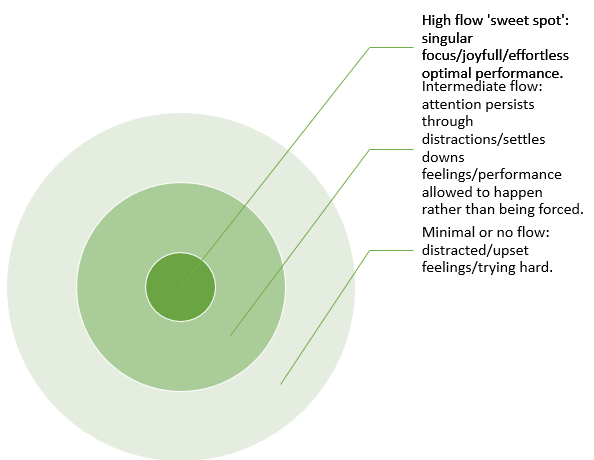
Flow is an individual experience, rooted in sport psychology's theory of an Individual Zone of Optimal Functioning. This means each person has their own subjective area of flow where they perform best, typically at moderate levels of psychological arousal—neither overwhelmed nor understimulated to the point of boredom.
The term "flow" comes from Csíkszentmihályi's 1975 interviews, where people described their experiences using the metaphor of a water current carrying them along, saying things like "It was like floating" or "I was carried on by the flow."
Research into flow began when Csíkszentmihályi became fascinated by artists, especially painters, who became so immersed in their work that they ignored food, water, and sleep. He sought to understand this phenomenon, and flow theory became prominent in the 1980s and 1990s, with Csíkszentmihályi and colleagues in Italy leading the way. Researchers focused on optimal experiences and positive states in settings like schools and businesses, and the cognitive science of flow has been studied under the concept of effortless attention.
Jeanne Nakamura and Csíkszentmihályi identified six factors that together constitute a
- field
- Positive psychology, occupational therapy
- known_for
- Concept of flow (being in the zone)
- first_presented
- 1975 book Beyond Boredom and Anxiety
- originator
- Mihály Csíkszentmihályi (Hungarian-American psychologist)
Lore & Background
The concept of flow was first presented in the 1975 book Beyond Boredom and Anxiety by Hungarian-American psychologist Mihály Csíkszentmihályi. Csíkszentmihályi and others began researching flow after he became fascinated by artists who would essentially get lost in their work. Artists, especially painters, got so immersed in their work that they would disregard their need for food, water and even sleep. The theory of flow came about when Csíkszentmihályi tried to understand the phenomenon experienced by these artists. Flow research became prevalent in the 1980s and 1990s, with Csíkszentmihályi and his colleagues in Italy still at the forefront. Researchers grew interested in optimal experiences and emphasizing positive experiences, especially in places such as schools and the business world. The cognitive science of flow has been studied under the rubric of effortless attention.
Flow is so named because, during Csíkszentmihályi's 1975 interviews, several people described their 'flow' experiences using the metaphor of a water current carrying them along: 'It was like floating,' 'I was carried on by the flow.' The flow state shares many characteristics with hyperfocus. However, hyperfocus is not always described in a positive light. Some examples include spending 'too much' time playing video games or becoming pleasurably absorbed by one aspect of an assignment or task to the detriment of the overall assignment. Hyperfocus is often mentioned 'in the context of autism, schizophrenia, and attention deficit hyperactivity disorder – conditions that have consequences on attentional abilities.'
Reader's Guide
Flow is an individual experience and the idea behind flow originated from the sport psychology theory about an Individual Zone of Optimal Functioning. The individuality of the concept of flow suggests that each person has their subjective area of flow, where they would function best given the situation. One is most likely to experience flow at moderate levels of psychological arousal, as one is unlikely to be overwhelmed, but not understimulated to the point of boredom. Jeanne Nakamura and Csíkszentmihályi identify six factors encompassing a flow experience: intense and focused concentration on the present moment; merging of action and awareness; loss of reflective self-consciousness; a sense of personal control or agency; distortion of temporal experience; and experience of the activity as intrinsically rewarding (autotelic experience). Additionally, psychology writer Kendra Cherry has mentioned three other components: immediate feedback; feeling the potential to succeed; and feeling so engrossed that other needs become negligible. In 2021, Cameron Norsworthy and colleagues proposed a framework differentiating flow antecedents and experiential dimensions, identifying optimal challenge, high motivation, absorption, effort-less control, and intrinsic reward as core elements. Flow has been widely referred to across a variety of fields and is particularly well recognized in occupational therapy. Despite the attraction of flow and varying flow interventions, there has existed no gold standard intervention to promote flow experiences, though Norsworthy et al. found continued evidence that it may be possible to 'train' flow through an educational intervention.
Did You Know?
- Flow is so named because interviewees described the experience using the metaphor of a water current carrying them along, such as 'It was like floating.'
- The concept was first presented in the 1975 book Beyond Boredom and Anxiety by Hungarian-American psychologist Mihály Csíkszentmihályi.
- Flow research became prevalent in the 1980s and 1990s, with Csíkszentmihályi and his colleagues in Italy still at the forefront.
- The flow state shares many characteristics with hyperfocus, but hyperfocus is often mentioned in the context of autism, schizophrenia, and attention deficit hyperactivity disorder.
Origins in the Studio
The concept of flow traces its roots to a simple observation made by Hungarian-American psychologist Mihály Csíkszentmihályi. He became captivated by watching artists—particularly painters—become so utterly consumed by their creative work that they would neglect basic human necessities like eating, drinking, and sleeping. Driven to understand what was happening inside those artists' minds, Csíkszentmihályi set out to study the phenomenon systematically. The result was his 1975 book Beyond Boredom and Anxiety, which introduced the term to the psychological world. The name itself emerged organically from his interviews: multiple participants independently described their peak experiences using water imagery, saying things like "It was like floating" or "I was carried on by the flow." By the 1980s and 1990s, Csíkszentmihályi and his Italian colleagues had pushed flow research into the mainstream, with scholars turning their attention to optimal experiences in classrooms, workplaces, and everyday life. The concept has since found a particularly strong home in occupational therapy.
Anatomy of the State
Jeanne Nakamura and Csíkszentmihályi distilled the flow experience into six interlocking components: an intense, present-moment concentration; a merging of action with awareness; the fading of reflective self-consciousness; a felt sense of personal agency over the activity; a distortion in how time is subjectively experienced; and the perception that the activity is intrinsically rewarding, a quality they called autotelic. These elements can surface independently, but only their convergence produces what we recognize as flow. Csíkszentmihályi later added three further conditions—immediate feedback, a felt potential to succeed, and the neglect of other bodily needs during deep engagement. In 2021, Cameron Norsworthy and colleagues proposed a streamlined framework that separated flow's antecedents from its experiential dimensions. They identified optimal challenge (a perceived ability to meet demanding conditions) and high motivation as the two overarching antecedents, while absorption, effortless control, and intrinsic reward described the experience itself. Their working definition captured the essence: flow is an intrinsically rewarding absorption in a task where a high degree of control paradoxically feels less effortful than usual.
Flow and Its Shadow: The Hyperfocus Distinction
The flow state shares a striking structural resemblance with hyperfocus, yet the two are rarely discussed in the same emotional register. Hyperfocus is frequently described in less flattering terms: a person might spend what others consider "too much" time absorbed in video games, or become so pleasurably locked into one sub-task that the broader assignment suffers. In some cases, hyperfocus can effectively "capture" an individual, making them appear scattered or causing them to launch multiple projects they never finish. Clinically, hyperfocus is often discussed in the context of autism, schizophrenia, and attention deficit hyperactivity disorder—conditions that carry specific consequences for attentional regulation. Flow, by contrast, is framed as a positive, energized state. It is even recommended as a coping strategy for managing stress and anxiety, provided the leisure activity genuinely matches the person's skill set. The distinction matters: both involve deep absorption, but flow is characterized by enjoyment, balance between skill and challenge, and a sense of agency, whereas hyperfocus can feel involuntary and disruptive.
The Individual Architecture of Attention
Flow is not a one-size-fits-all phenomenon. The concept grew out of sport psychology's theory of an Individual Zone of Optimal Functioning, and that individuality runs through every aspect of the state. Each person possesses a subjective sweet spot where their skills and the task's demands align just right—challenging enough to prevent boredom, yet not so demanding as to trigger overwhelm. This balance is best reached at moderate levels of psychological arousal. The cognitive science of flow has been explored under the label "effortless attention," and the numbers behind it are humbling. Csíkszentmihályi noted in his 2004 TED talk that the human mind can process roughly 110 bits of information per second. Simply decoding spoken language consumes 40 to 60 of those bits, which explains why a conversation leaves little bandwidth for parallel tasks. In flow, however, the mind channels its full attentional budget into a single activity without any conscious decision to do so. Time, surrounding people, distractions, and even hunger or pain simply fall away, leaving the person completely engrossed in the task at hand.
Gallery

Frequently Asked Questions
Who is Flow (psychology)?
Flow is a mental state in positive psychology where a person becomes fully absorbed in an activity, experiencing intense focus, deep involvement, and pure enjoyment in the process itself. It is commonly nicknamed "being in the zone" and was formally introduced by Hungarian-American psychologist Mihály Csíkszentmihályi in his 1975 book Beyond Boredom and Anxiety.
What are Flow (psychology)'s powers/role?
Flow merges action and awareness into a single stream of experience, distorts the person's sense of time, and produces a feeling of energized concentration. It typically emerges when a task's difficulty sits right at the edge of the person's skill level, creating a sweet spot between boredom and anxiety.
How does Flow (psychology)'s story end?
Flow is not a narrative with a fixed ending; it is a temporary state that fades once the activity stops or the person's focus breaks. In practice, people often return to it repeatedly as a way to cope with stress and anxiety by productively channeling their energy into leisure that matches their abilities.
Why is Flow (psychology) important?
Flow matters because it shows that peak human experience can arise from the activity itself rather than from external rewards. It has become a cornerstone concept in positive psychology and occupational therapy, guiding how people design work, play, and recovery to sustain well-being.
Who created Flow (psychology)?
The concept was originated by Mihály Csíkszentmihályi, a Hungarian-American psychologist, who first presented it in his 1975 book Beyond Boredom and Anxiety. His work laid the groundwork for flow to become a central idea in positive psychology and related therapeutic fields.
More in Emotions 1-21
Spotted an error? Know more?
This is a living reference — every entry is fact-audited, and reader corrections feed straight into our audit queue. Suggest an edit · See this site's audit record